KAI expanded its Seki Magoroku Kaname kitchen-knife series on 19 October 2026, adding four blade shapes: a small 90 mm Kiritsuke, a 165 mm Nakiri for vegetables, a 225 mm serrated bread knife and a 240 mm Sujihiki for slicing meat. Japanese list prices range from ¥22,000 to ¥30,800 including tax. The key change is choice: the line now reaches beyond its original Kiritsuke-shaped multipurpose knives into more specialised kitchen tasks.
The announcement is particularly interesting for cooks comparing Japanese knife shapes. Despite its name, the new 90 mm Kiritsuke is designed for small, precise jobs, not the same work as a long, traditional Japanese Kiritsuke. The Nakiri, meanwhile, has a distinct role from a Santoku, and the 240 mm Sujihiki is built for long slicing strokes.
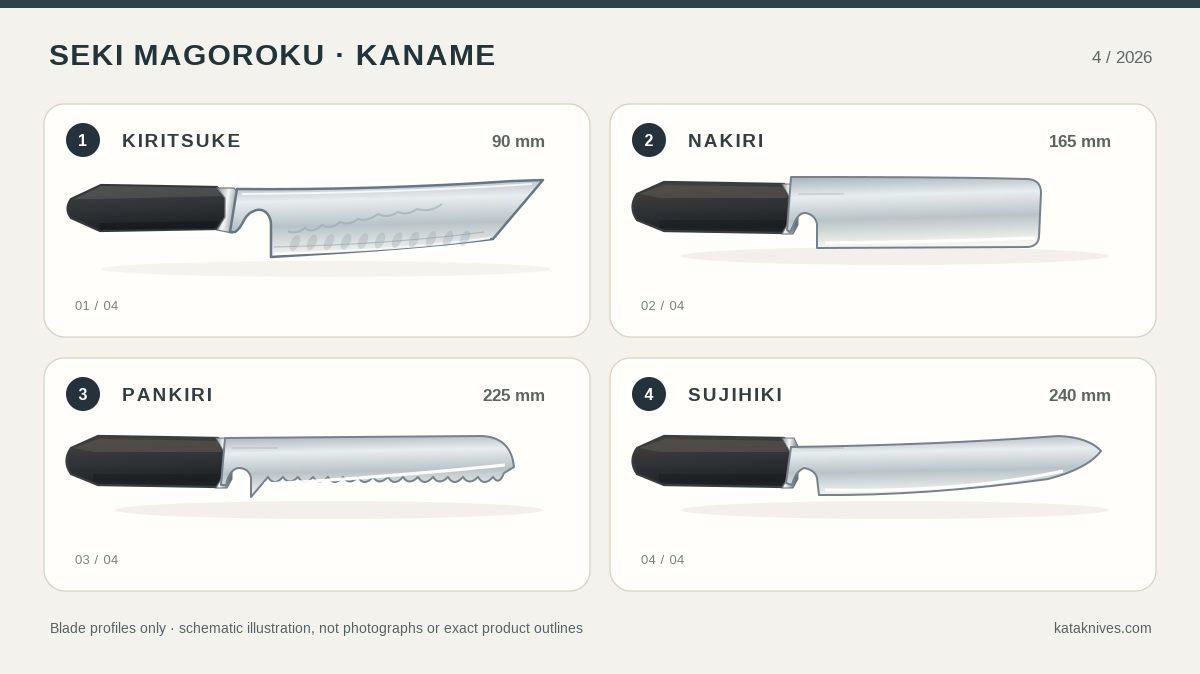
Illustration: blade-type comparison, not photographs or exact outlines of the KAI products. The linked official product pages below show the actual knives.
Four new Kaname knives: blade length and Japanese price
| New model | Blade length | Price in Japan (tax included) | Intended work |
|---|---|---|---|
| Kiritsuke 3 sun | 90 mm | ¥22,000 | Peeling, trimming, decorative cuts |
| Nakiri 5.5 sun | 165 mm | ¥26,400 | Cutting leafy and root vegetables |
| Serrated knife 7.5 sun | 225 mm | ¥30,800 | Crusty and soft breads |
| Sujihiki 8 sun | 240 mm | ¥30,800 | Slicing roast beef and other boneless meats |
These are KAI’s published Japanese retail prices, checked on 27 October 2026. They are not converted overseas prices; selection and arrival dates can differ by retailer. The new models join existing Kiritsuke-shaped Kaname knives at 120, 150 and 195 mm.
Kiritsuke 90 mm: why such a short blade?
At 90 mm, this knife is closer in daily use to a small utility or paring knife. KAI points to peeling, removing stems and making fine decorative cuts. Keeping the tip close to the hand can help with small ingredients where a 195 mm blade feels awkward.
The word Kiritsuke needs context. A traditional Japanese Kiritsuke is often a long, single-bevel knife associated with specialised professional work. The Kaname 90 mm borrows the angular tip silhouette; its name does not make it a direct substitute for a traditional Kiritsuke. See our Kiritsuke knife guide for the wider range of shapes and uses.
Nakiri 165 mm: why choose it over a Santoku?
The new Nakiri uses a tall, broad blade and a comparatively straight cutting edge for repeated board contact. Preparing cabbage, leeks or root vegetables is a natural use for this shape. Its 165 mm length fits between the small precision Kiritsuke and the much longer Sujihiki.
A Nakiri is primarily a vegetable knife, whereas a Santoku is designed as a general-purpose tool for vegetables, boneless meat and fish. For someone whose main work is vegetable preparation, the Nakiri’s edge profile may be more useful than a pointed tip. Neither is intended for splitting bones or frozen food.
Sujihiki 240 mm and serrated 225 mm: two different slicing tasks
The 240 mm Sujihiki has the reach needed to slice a roast or block of meat in a longer, controlled stroke. Its narrow slicing profile serves a different role from a general-purpose Gyuto. For cooks who prepare large roasts occasionally, the main trade-off is whether that specialised length justifies its storage space.
The 225 mm serrated model addresses the opposite texture problem: a firm crust surrounding soft bread. Its teeth grip the crust while the long blade cuts through a loaf. Serrations require a different sharpening approach from a plain edge; flattening the teeth with an ordinary whetstone would damage their profile. Our bread-knife guide explains how this shape differs from a straight-edged kitchen knife.
What is different about the Kaname construction?
KAI describes the Kaname series as drawing on Japanese sword design, notably a gently curved spine known as torii-zori, and an octagonal wooden handle. The blade construction is a layered stainless composite with a special stainless cutlery-steel core; the product specifications list laminated reinforced wood for the handle. KAI’s design account also discusses fine blade thinning and the distinctive angular tip.
The Kaname series received a Red Dot product-design award in 2023. That award applies to the series’ established design; it was not a new award for these four October 2026 models.
Maintenance and where to check availability
KAI recommends washing with mild detergent, rinsing, wiping dry and storing the knives away from moisture. Its official store also describes a paid professional sharpening service. For the straight-edged models, see our Japanese whetstone sharpening guide; for the serrated bread knife, follow advice specific to its teeth.
KAI announced sales beginning 19 October 2026 through its Japanese online store, directly operated shops, department stores and selected specialist retailers. Stores may receive stock on different days. The model links in the comparison table lead to the manufacturer’s product specifications and current Japanese listings.