If you occasionally prepare a whole chicken and want to remove meat cleanly from bones, a Honesuki around 150 mm is the natural first knife to consider. If joint and cartilage work forms a large part of your regular cooking, look closely at the thicker Garasuki around 180 mm. If whole fish are your usual starting point, a Deba answers a different need; it can also handle certain poultry tasks.
Removing meat from the bone
A Santoku or Gyuto easily cuts a boneless chicken breast into portions. A whole bird presents a different shape: the thigh meets the body at a joint; tendons hold a wing in place; breast meat follows the ridge of the breastbone. Simply pressing a large blade down can meet a hard bone or waste meat. The useful movement is often a short, controlled cut with the point, following the surface of the skeleton.
That explains the Japanese word Honesuki. Despite containing hone, meaning bone, it is primarily a tool for removing meat from bones, not an axe for splitting them. The Japanese knife manufacturer and retailer Nihonbashi Kiya describes the pointed, robust blade as a tool for precise work around bones. The tip is easy to guide while the blade is firm enough for specialised preparation.
But a kitchen that breaks down several birds has another challenge. Joints and cartilage demand more from the blade than delicate trimming does. That is where the heavier Garasuki starts to make sense. Comparing the two is more useful than assuming that all Japanese boning knives perform the same task.
Honesuki, Garasuki and Deba: differences in shape and purpose
Honesuki: tracing the bone without wasting the meat
The Honesuki’s characteristic point can reach tight spaces around the thigh joint, the wing and the breastbone. In its Japanese catalogue, Sakai Kikumori, the brand of Kawamura Hamono, lists both angular and rounded Honesuki patterns at 150 mm. This compact size is one reason the knife can be handled precisely.
There is more than one Honesuki design. Point shape and bevel geometry can vary, and some manufacturers make versions intended for different types of meat preparation. When buying abroad, look beyond a product photograph labelled ‘Japanese boning knife’. Check the actual blade length, edge orientation and whether the manufacturer describes the model for poultry or other meat.
Garasuki: why more thickness matters around poultry joints
The name Garasuki relates to gara, the poultry carcass. Sakai Ichimonji Mitsuhide compares it directly with Honesuki on its Japanese website. Its representative Honesuki has a blade around 150 mm, while its Garasuki is about 180 mm, thicker and heavier. The shop identifies joints and cartilage as important Garasuki tasks. Sakai manufacturer and wholesaler Takahashi Kusu also describes Garasuki as a larger blade for breaking down chicken and removing meat from the frame.
A 30 mm difference in length is easy to notice on a catalogue page. In the kitchen, though, extra thickness and weight are just as important. Honesuki offers control when tracing a curve of bone. Garasuki provides a more substantial edge for the repetitive, tougher work around a carcass. These are tendencies, not a guarantee that every model has the same measurements or grind.
A robust poultry knife should still be used within its intended range. Do not try to split a large, hard bone by forcing a fine tip or striking the edge. For that particular task, use a tool specifically rated for cutting bone.
Deba: why is a fish knife part of this comparison?
The Deba is a broad, thick Japanese knife associated with removing fish heads, filleting and working near fish bones. The Sakai cutlery trade association also lists chicken among its possible uses. It would therefore be misleading to say a Deba can only be used for fish.
The difference is the work each blade makes comfortable. A substantial Deba heel is useful in fish preparation, while its broad, heavy profile is less nimble than a pointed Honesuki around a small poultry joint. A cook who already owns a Deba may use it for selected poultry tasks. Someone buying a knife mainly to free meat from a chicken frame will usually gain more control from a specialised poultry or boning knife.
Three profiles, three intended movements
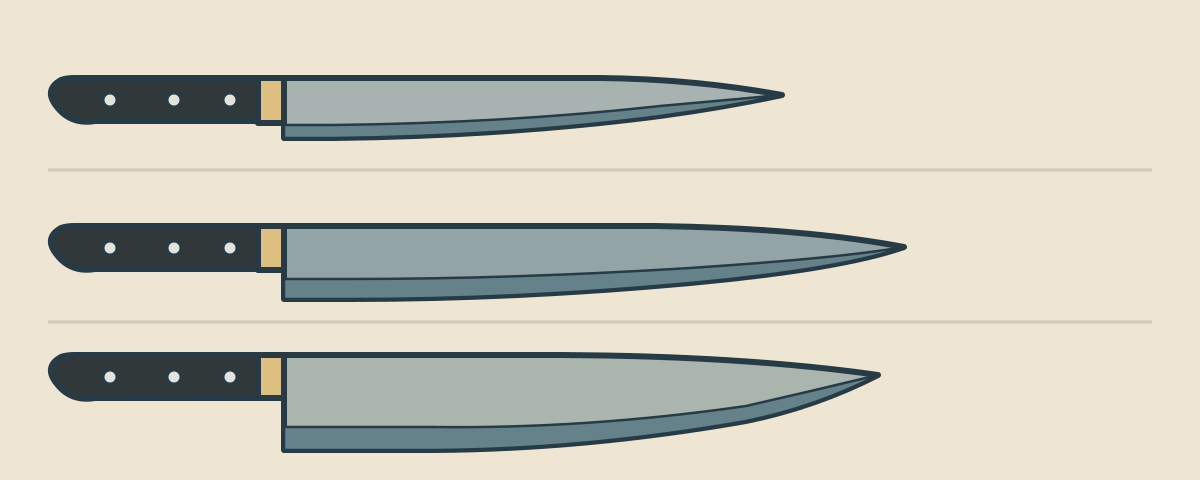
Illustration: Honesuki at the top, Garasuki in the middle and Deba at the bottom. This is a comparison of general blade profiles, not an exact photograph or a scale drawing of specific products.
| Work or characteristic | Honesuki | Garasuki | Deba |
|---|---|---|---|
| Representative blade length | Around 150 mm | Around 180 mm | Depends on model and fish size |
| General form | Compact, pointed | Heavier, thicker poultry blade | Broad, thick fish knife |
| Remove meat from poultry bones | Particularly suitable | Suitable, but heavier | Possible; less nimble for detail |
| Work around joints and cartilage | Controlled tip work | Especially useful | Depends on the particular task |
| Fillet a whole fish | Not its specialism | Not its specialism | Main task |
| Large hard bones | Do not force the edge | Use a suitable dedicated cutter | Use the appropriate part and follow maker guidance |
The Honesuki and Garasuki lengths are examples published by Sakai Ichimonji and Sakai Kikumori, not universal specifications.
How to use each knife and choose the right one
How the knife choice changes during one chicken breakdown
Start with the leg. After cutting through the skin, move the leg to locate where it joins the body. A pointed Honesuki can follow the bone with short, deliberate cuts; Garasuki can do the same, although its weight makes finer movements less delicate. Find the joint rather than trying to push the blade through an intact thick bone.
Next comes the breast. The meat lies against the breastbone, so each short movement of the tip should follow that structure. A lighter Honesuki earns its place here. Once the meat is free, an ordinary Gyuto can finish slicing it into portions. The speciality knife need not stay in your hand for every stage of cooking.
Around the wings and cartilage, the Garasuki has a stronger case. If a cook repeatedly dismantles whole birds, its thicker blade can make demanding joint work more comfortable. For a home cook preparing an occasional chicken, however, the smaller Honesuki is often sufficient. The difference becomes clearer through frequency and type of work, not through the price tag alone.
Finally, the remaining carcass may be kept for stock. If it needs cutting into smaller pieces to fit the pot, first decide whether that requires cutting through hard bone. Use a suitable bone-cutting tool when necessary rather than treating the narrow point of a Honesuki like a cleaver.
Single bevel, double bevel and left-handed use
An international buyer may assume every Japanese knife is single-bevel. Honesuki and Garasuki are sold with different grinds: some have distinctly asymmetric edges, and others have bevels on both sides. This matters when sharpening and when choosing a knife for a left-handed cook. Inspect the exact maker’s specifications rather than relying on the category name.
Traditional Deba knives are commonly single-bevel, with a wide blade road and specialised back geometry. Double-bevel versions also exist. Grinding both sides symmetrically without examining the actual edge can change the maker’s intended shape. Our whetstone sharpening guide covers the difference between sharpening ordinary double-bevel knives and traditional single-bevel blades.
Raw chicken: hygiene is part of using the knife properly
A whole chicken leaves raw juices on hands, boards and blades. Japan’s Ministry of Agriculture, Forestry and Fisheries advises against washing raw chicken, because splashing water can spread bacteria around the kitchen. Wash hands and utensils thoroughly, keep raw poultry equipment away from ingredients that will be eaten without cooking, and cook poultry to a core temperature of at least 75°C for at least one minute.
After cutting, remove fat and moisture from the knife and dry it thoroughly. Carbon-steel versions demand particular care against rust. Whichever knife you choose, safe cleaning and storage are as important as sharpness.
Explore the Honesuki guide and the Deba guide for more on individual knife types.