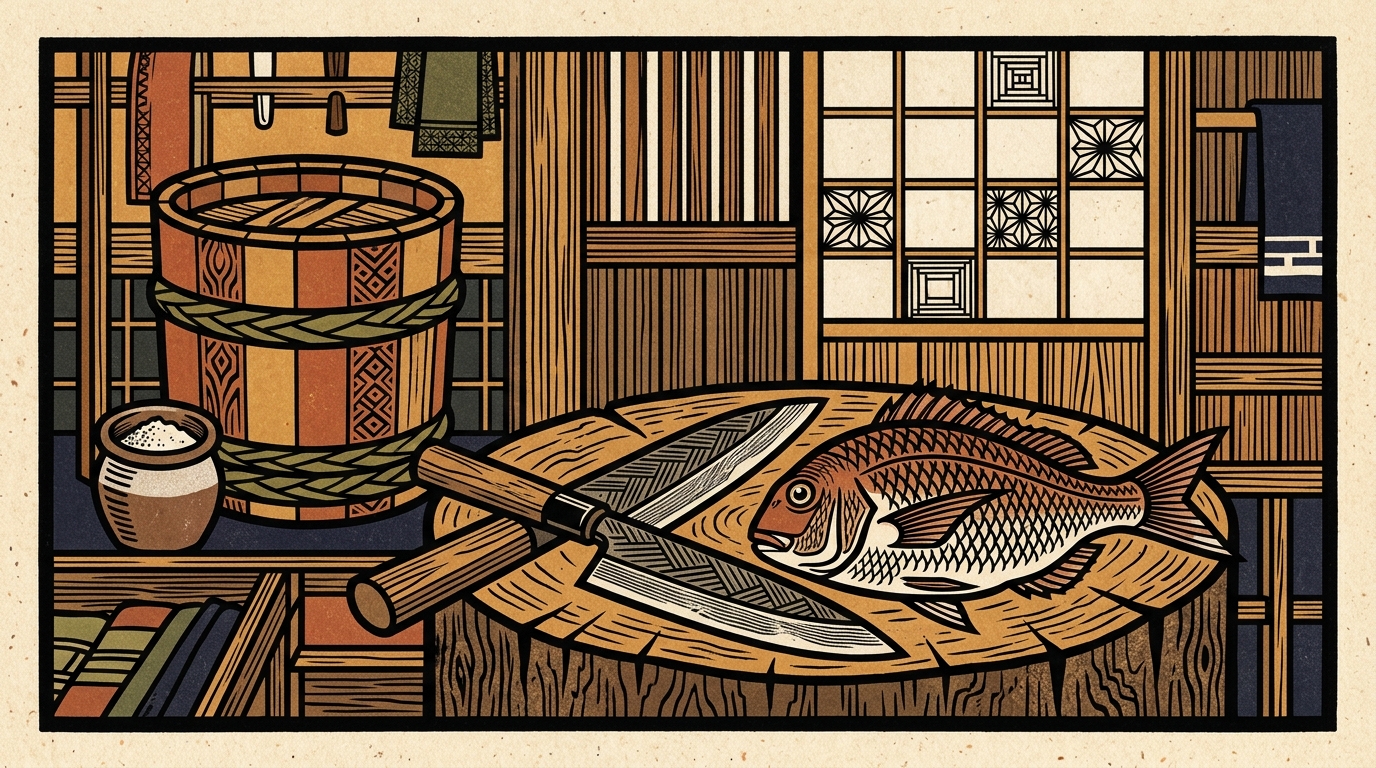
Bevel Type Analysis
Single Bevel (Kataba)
Traditional blades are flat or slightly concave on the back ( ) and beveled only on the front. This enables clean, razor-sharp surgical slices without pushing or squeezing foods—highly favored by Japanese sushi and sashimi chefs.
Single vs Double Bevel Cut Mechanics
Deba (Fish Filleting)
Deba (出刃)
Description
Deba is a comparatively thick, heavy Japanese knife traditionally used to prepare whole fish. Many traditional models have a single-bevel edge and require attention to handedness and sharpening geometry. Its strength does not make it chip-proof: avoid forceful impacts, hard bones and twisting, and follow the maker's intended-use guidance.
Best For
Blade Characteristics
- Traditional Deba knives often have a single bevel and a concave back (urasuki); check handedness.
- A comparatively thick spine is common, but thickness varies by model.
- Blade lengths often span approximately 120–210 mm, depending on intended fish size.
- Use the heel only for the maker-approved fish preparation tasks; thick blades can still chip.
Choosing steel
Blade shape alone does not determine the best steel. Compare corrosion resistance, sharpening requirements, blade geometry and the individual maker's instructions.
Compare carbon and stainless steel or see our steel-family guide.
Famous Regions
This cutlery type is famously forged and crafted in:
Choose and care for this knife
Blade shape is just one part of the decision. Compare your workspace, sharpening routine, steel preference and the exact maker specifications.
Six Japanese kitchen knife shapes compared
Use these approximate ranges to make a shortlist; the dimensions and grinds of individual models vary. These are not product tests or universal specifications.
On narrow screens, scroll the comparison table horizontally to see all columns.
| Shape | Typical uses | Indicative length | Limits | Bevel and upkeep |
|---|---|---|---|---|
| Santoku | Everyday vegetables, boneless meat and fish | Usually 165–180 mm | Less tip reach than many Gyuto designs; not for bones | Usually double. Model-dependent; check steel and edge |
| Gyuto | Versatile prep, longer slicing strokes | Often 180–240 mm | Long blades need board clearance; not for bones | Usually double. Model-dependent; avoid twisting thin edges |
| Nakiri | Vegetable chopping and slicing | Often 150–180 mm | Limited pointed-tip work; not for bones | Usually double. Avoid hard cutting surfaces |
| Petty | Small produce, trimming and detail work | Often 90–150 mm | Not a substitute for a full-size main knife | Usually double. Protect small tip and edge |
| Deba | Whole-fish preparation with appropriate technique | Often 120–210 mm | Not chip-proof; avoid hard impacts and twisting | Traditional versions: single. Handedness and bevel-specific sharpening |
| Yanagiba | Draw-slicing boneless fish and sashimi | Often 210–330 mm | Not a chopping or bone-cutting knife | Traditional versions: single. Handedness and bevel-specific sharpening |
If you are undecided, usethe buying guide, knife typesandcare.