Craftsmanship & History
How Japanese kitchen knives are forged, heat-treated, sharpened and fitted with handles—and why methods differ among regions and makers.
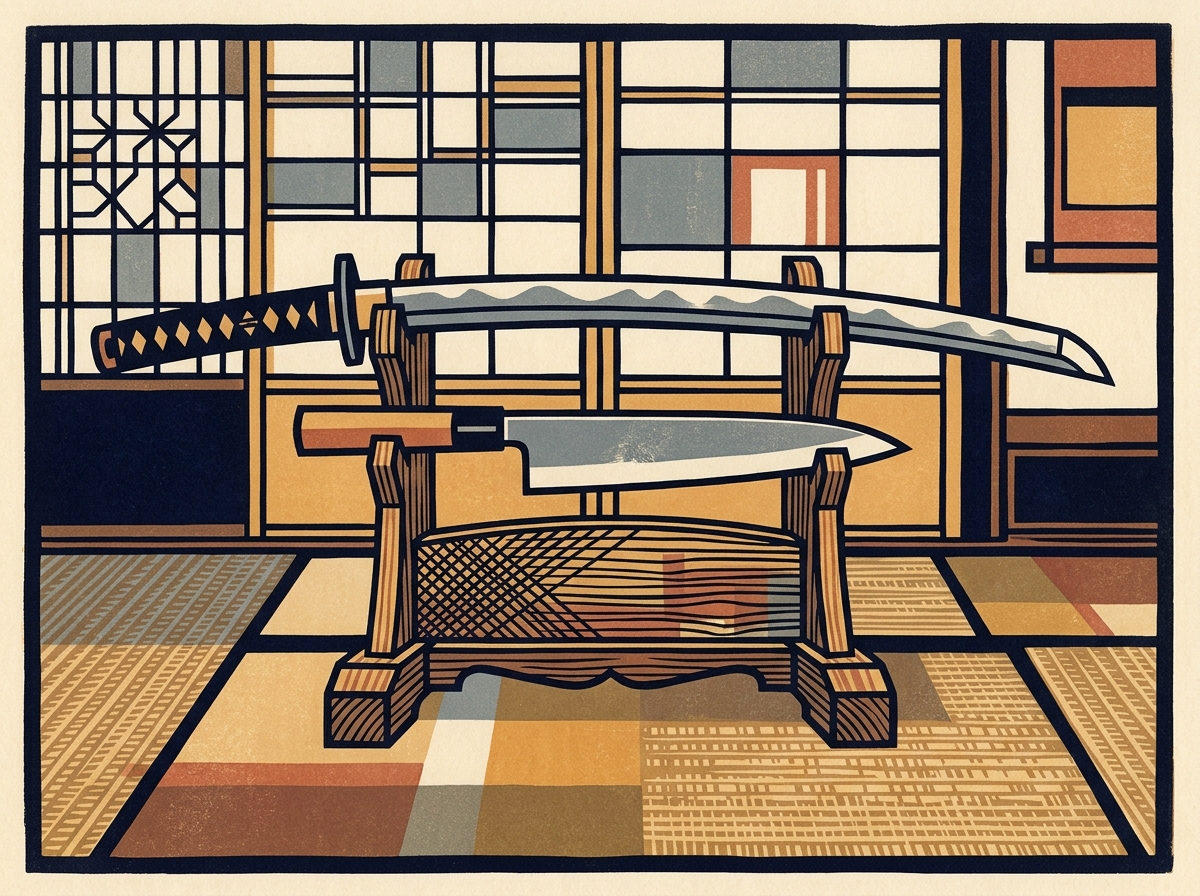
The Evolution from Katana to Kitchen
Japanese swordmaking and regional metalworking helped shape some cutlery traditions, but kitchen knives, farm tools and scissors also developed through distinct local crafts. There was no single nationwide transition from swordsmiths to kitchen-knife makers.
The 1876 Haitorei restricted wearing swords in public; it did not ban possession of Japanese swords. Some workshops diversified into civilian blades, while others followed separate manufacturing histories. Most modern kitchen knives use commercially produced cutlery steels, not tamahagane.
The 8 Steps of Sakai Blade Forging
Manufacturing sequences shown here are representative examples, not a universal recipe for every knife from a region. Methods, temperatures, tools and the order of operations vary by maker, blade construction and steel. Traditional swordmaking and tamahagane production are distinct from the manufacture of most modern kitchen knives.
For an official description of Sakai's forging, sharpening and handle-fitting divisions, see Sakai City and the Sakai Cutlery Association. Sakai City · Sakai Cutlery Association
Centuries-old heritage of fire-forging and forge-welding. Each blade is hand-hammered, heat-treated, whetted, and fitted one by one through master artisans' intuitive craftsmanship.
1. Hagane-tsuke & Tan-setsu (Forge-Welding Core Steel)
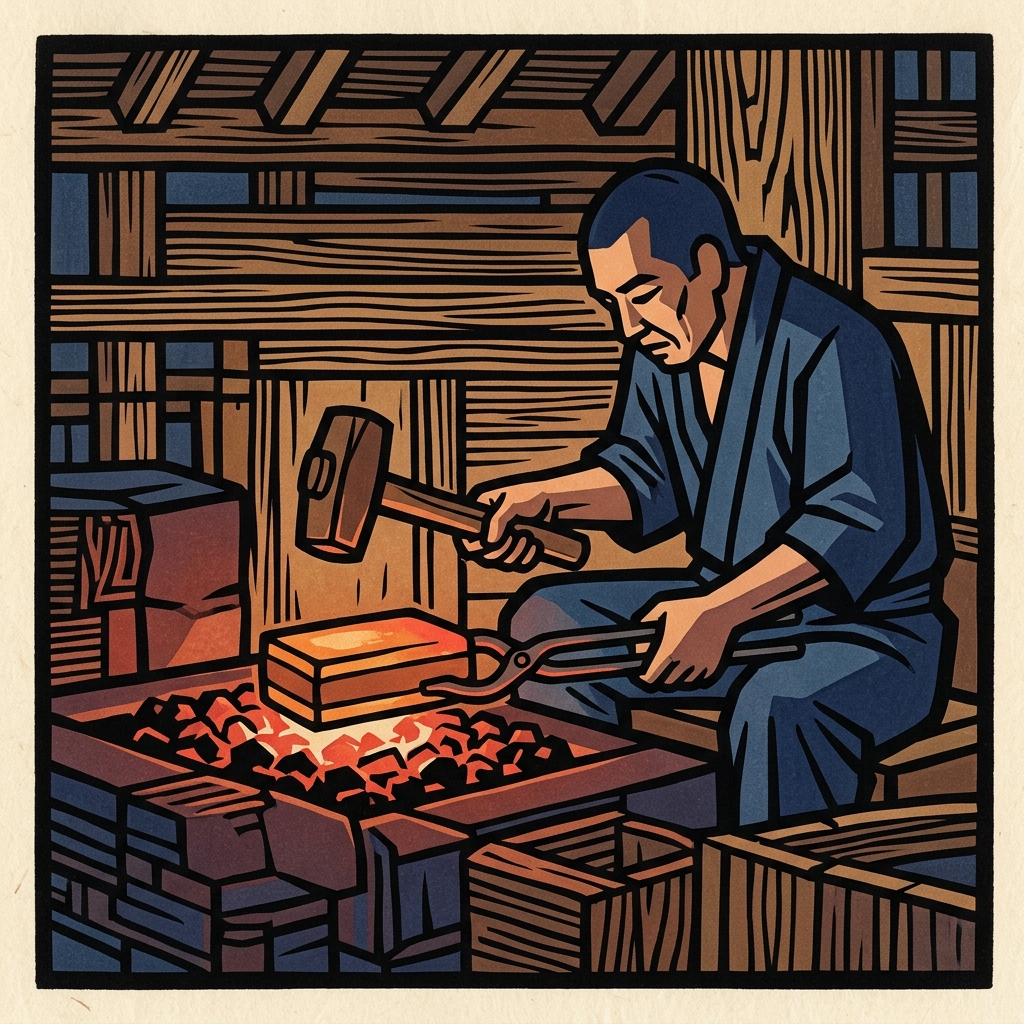
Applying a flux mixture (borax, boric acid, and iron scale) between soft iron (jigane) and high-carbon steel (hagane/shirogami or aogami), the smith heats them to ~1,000°C in the coke hearth and hammers them rapidly to achieve a permanent, atomic-level forge-weld while expelling slag.
2. Sakizuke & Nakagotori (Profile & Tang Forging)
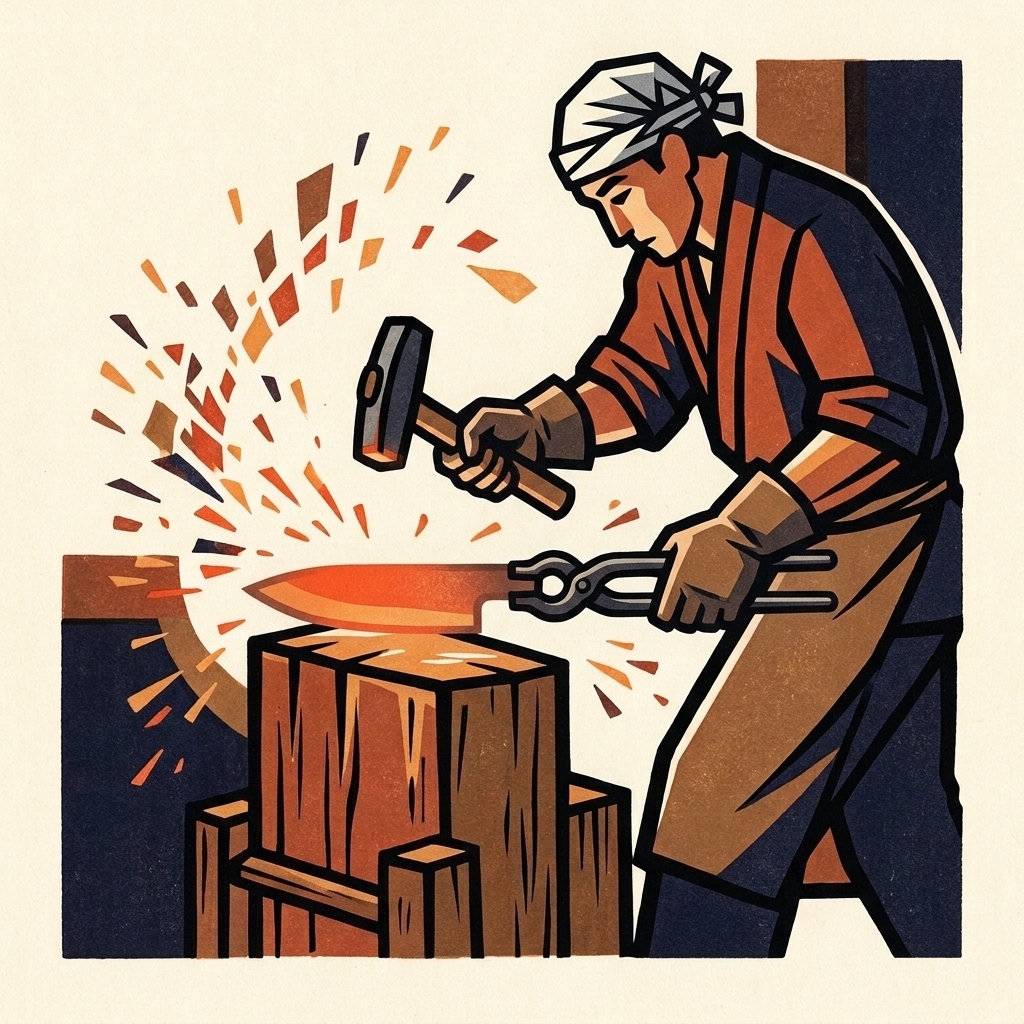
Under a rhythmic spring hammer, the smith draws out and tapers the red-hot composite billet, roughing out blade width, spine thickness, and primary bevels. The handle tang (nakago) is drawn out, and excess steel is cleanly severed with a hand-held cold chisel.
3. Aratataki & Urasuki (Cold Hammering & Hollow Grinding)
★ Signature Technique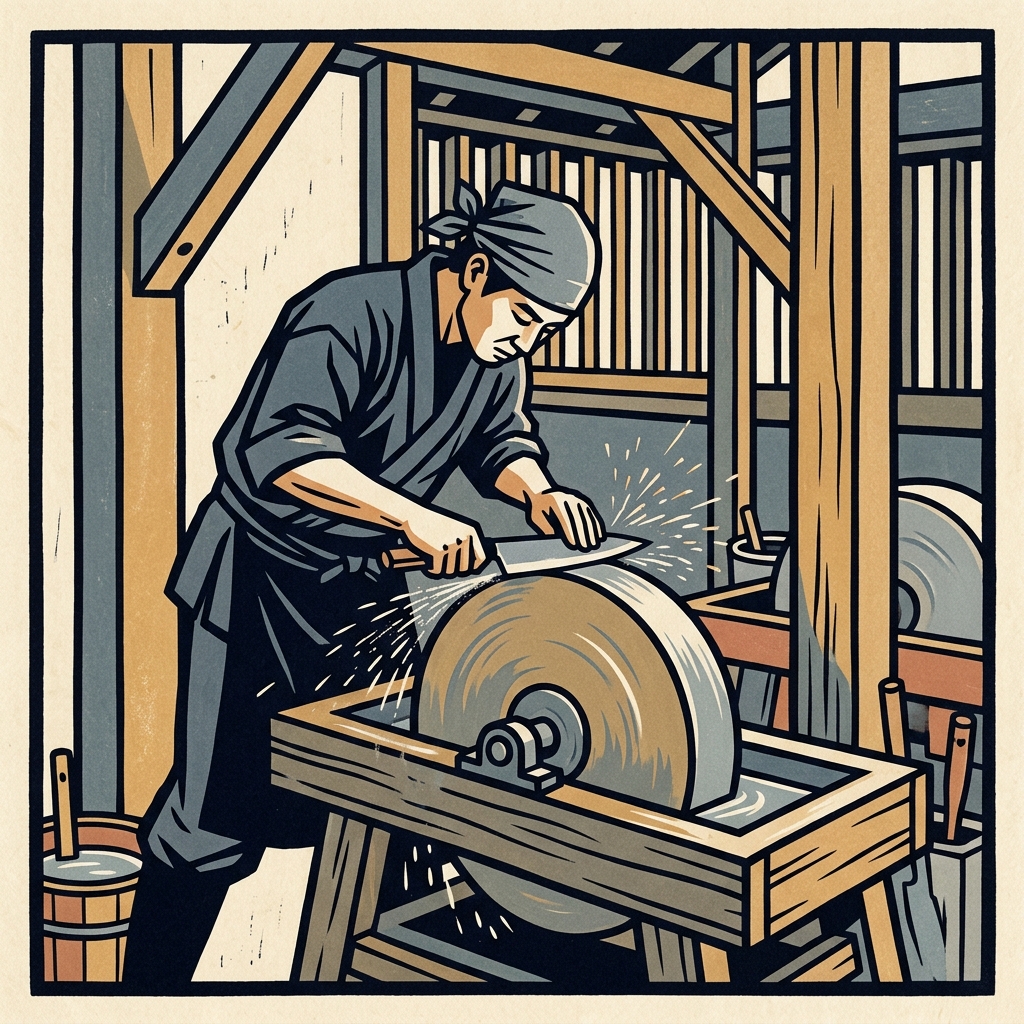
Once cooled, the blade is descaled of black oxide crust and cold-hammered to compact its internal crystalline grain structure. A large circular grinding wheel is then used to carve the signature concave hollow (urasuki) on the reverse flat face, establishing the geometry unique to traditional single-bevel knives.
The signature concave reverse hollow of single-bevel cutlery. Minimizing friction against food slices for effortless separation while enabling decades of maintenance via ura-oshi flat whetting.
4. Doro-nuri & Yaki-ire (Clay-Coated Water Quenching)
★ Signature Technique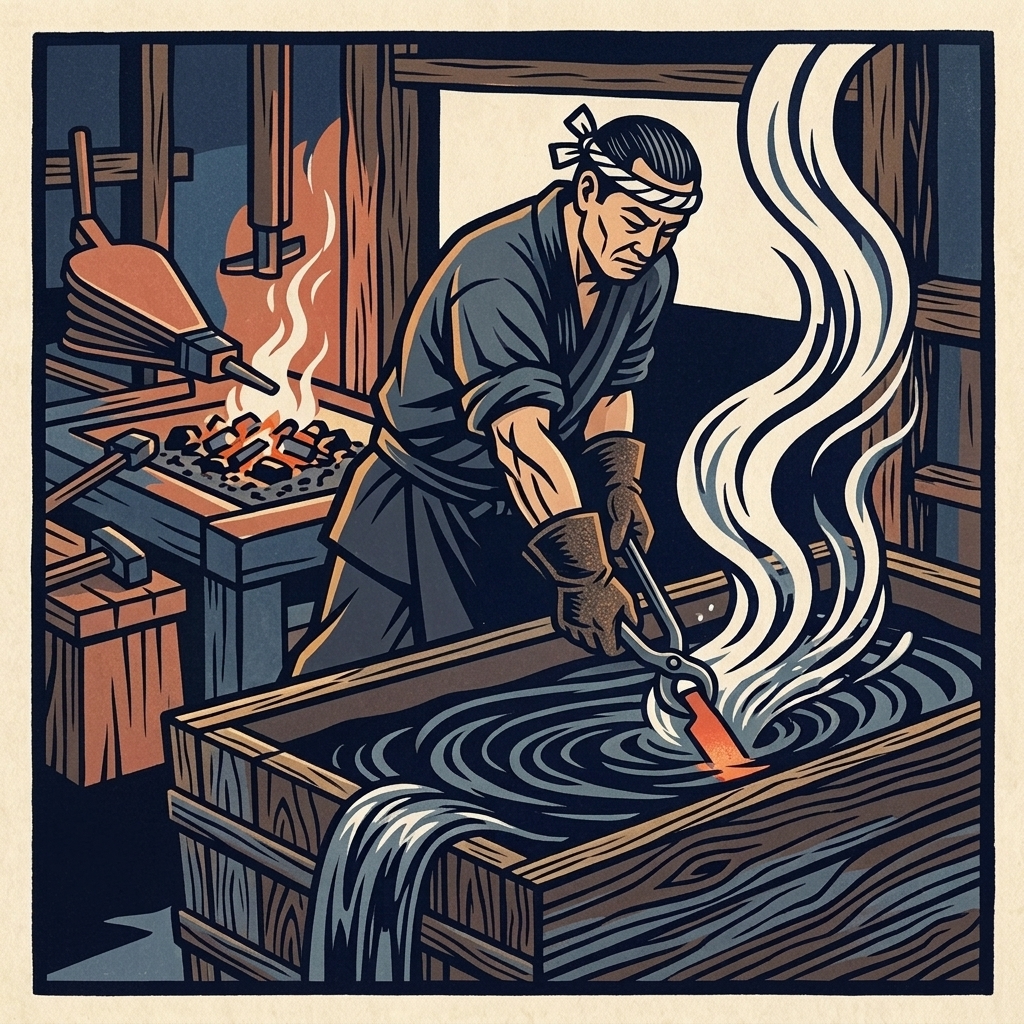
Artisans coat the degreased blade with a proprietary clay-and-stone powder wash to prevent vapor blankets from causing uneven cooling. In a dimly lit forge, the smith gauges radiant flame color to heat the blade to a precise 750–800°C, then plunges it into water, transforming the crystalline structure into maximum-hardness martensite.
Proprietary clay coating dissipates insulating steam pockets for instantaneous uniform cooling, locked in by the master smith's visual temperature discernment without pyrometers.
5. Yaki-modoshi & Hizumi-naoshi (Tempering & Straightening)
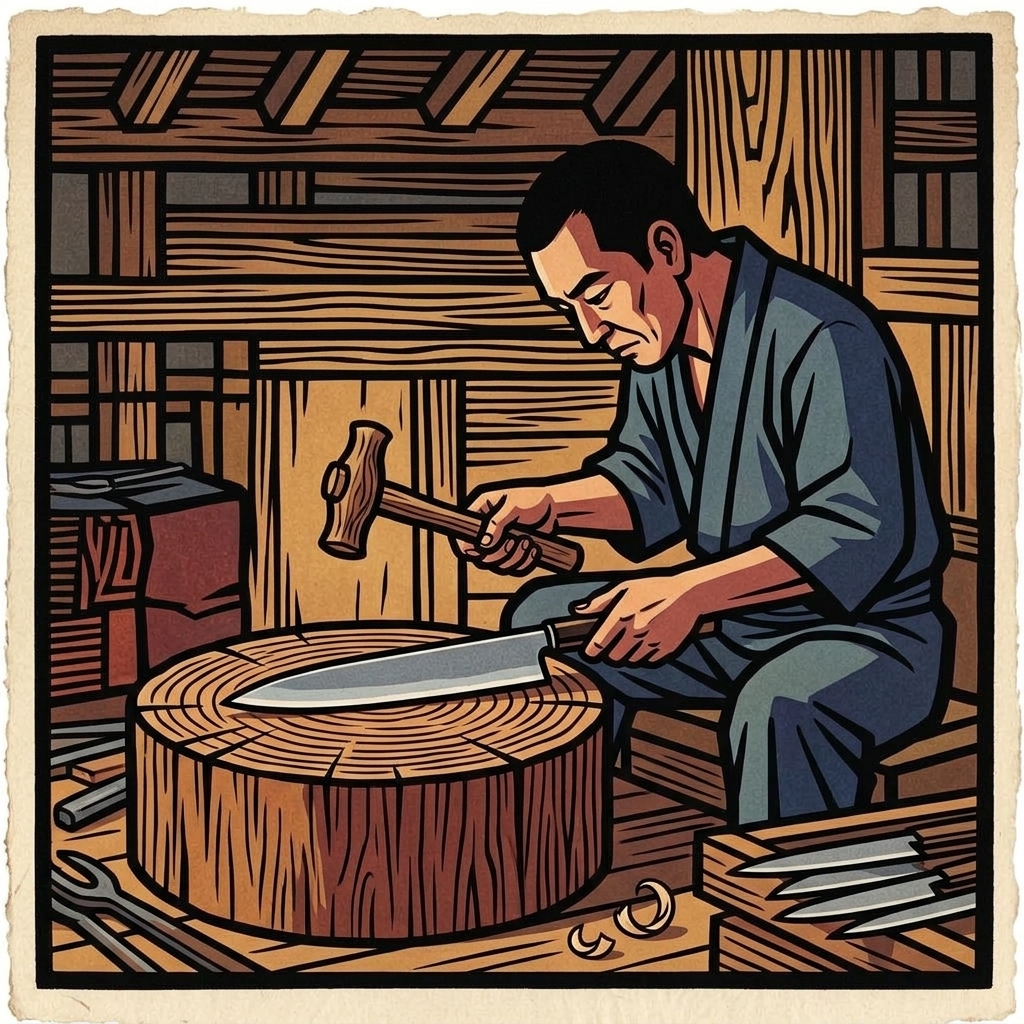
To relieve extreme quenching brittleness and impart cutting elasticity (toughness), the blade is reheated to ~160–180°C, judged by how scattered water droplets skitter across the blade spine. Any quenching curvature or torsional warps are corrected on a wooden anvil using specialized straightening hammers.
6. Hatsuke & Honbazuke (Master Waterstone Edge Honing)
Transferred to a dedicated sharpening master (Togishi), the blade undergoes progressive refinement on large rotary waterstones to form bevel angles and achieve a mirror kasumi finish. Using natural and fine synthetic bench stones, the artisan sets the micro-bevel (itobiki-ba) delivering razor sharpness demanded by culinary professionals.
7. E-tsuke & Kigumi (Heated Tang Friction Handle Fitting)
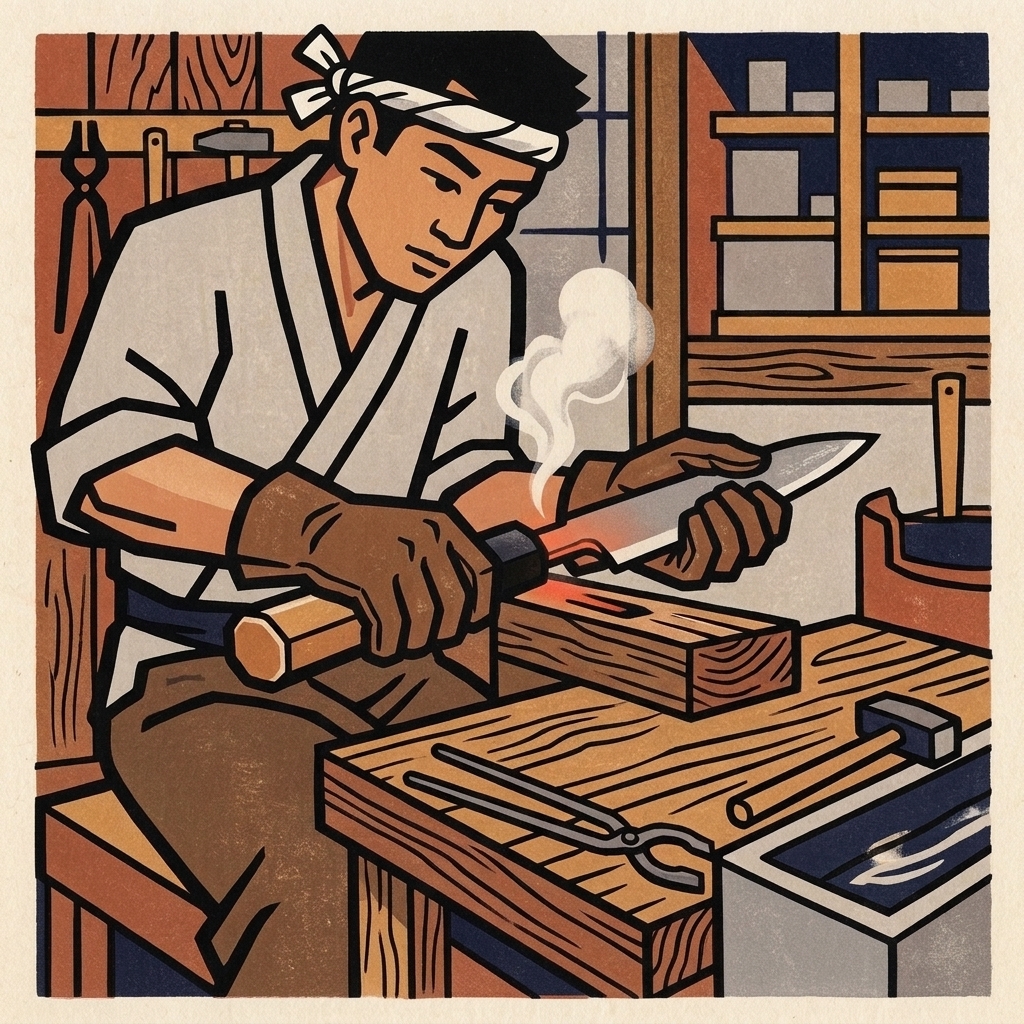
The tang tip is heated red-hot in the hearth and driven directly into traditional magnolia (ho) or ebony handles reinforced with water buffalo horn ferrules. The scorching wood creates an airtight, glue-free friction seal that prevents moisture ingress and tang corrosion over decades of culinary use.
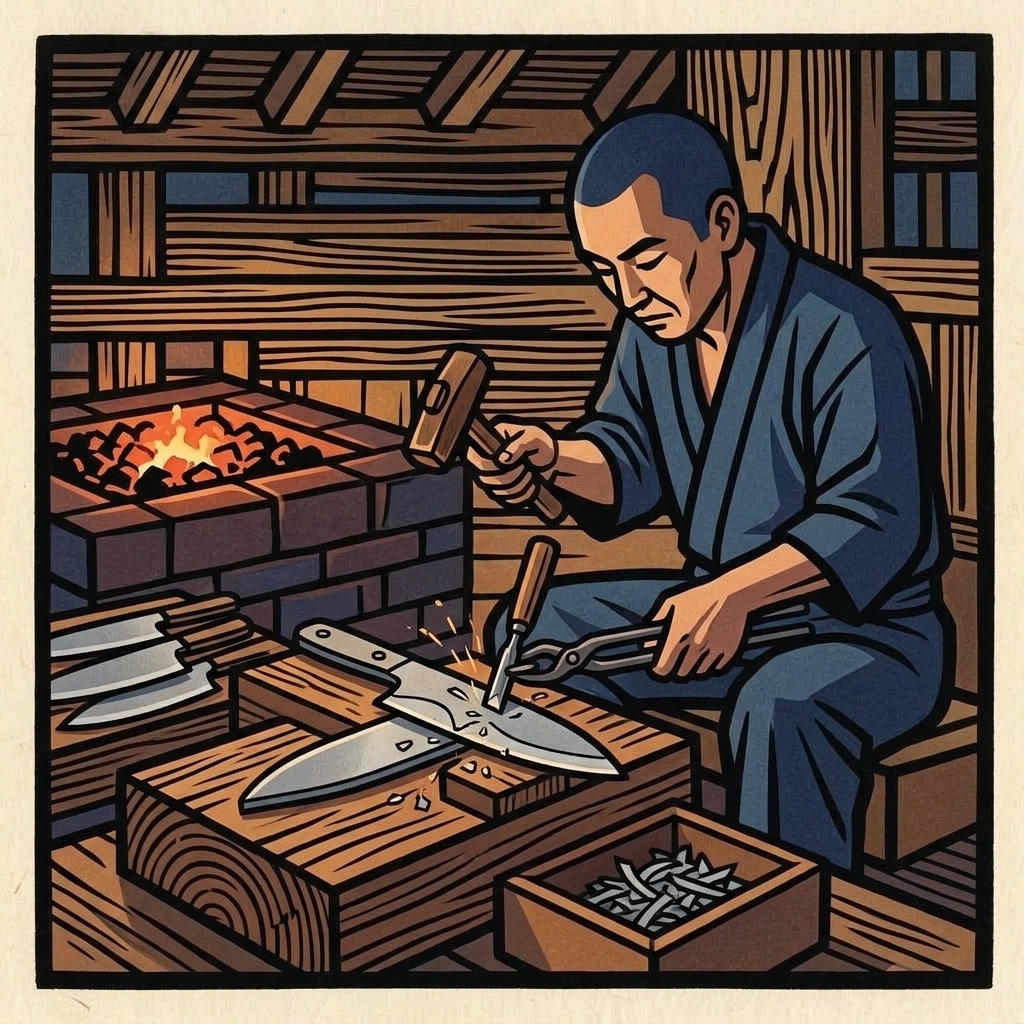
8. Meikiri & Final Inspection (Chisel Signature & Quality Check)
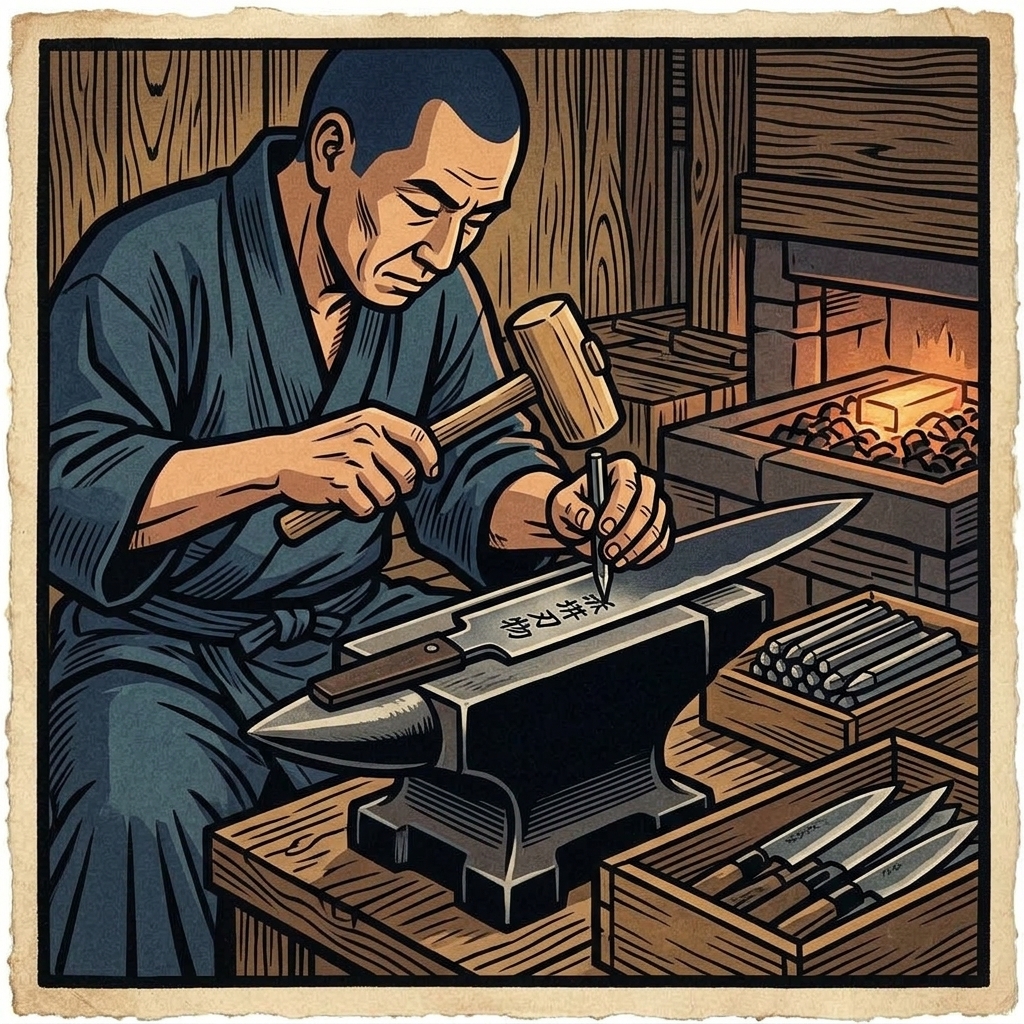
Resting the blade on a lead block, an artisan taps cold chisels to hand-carve the official 'Sakai Uchihamono' origin mark, master smith cipher, or custom chef dedication. After thorough cleaning, every knife undergoes exhaustive sensory inspections for spine straightness, blade balance, and paper-shaving sharpness.