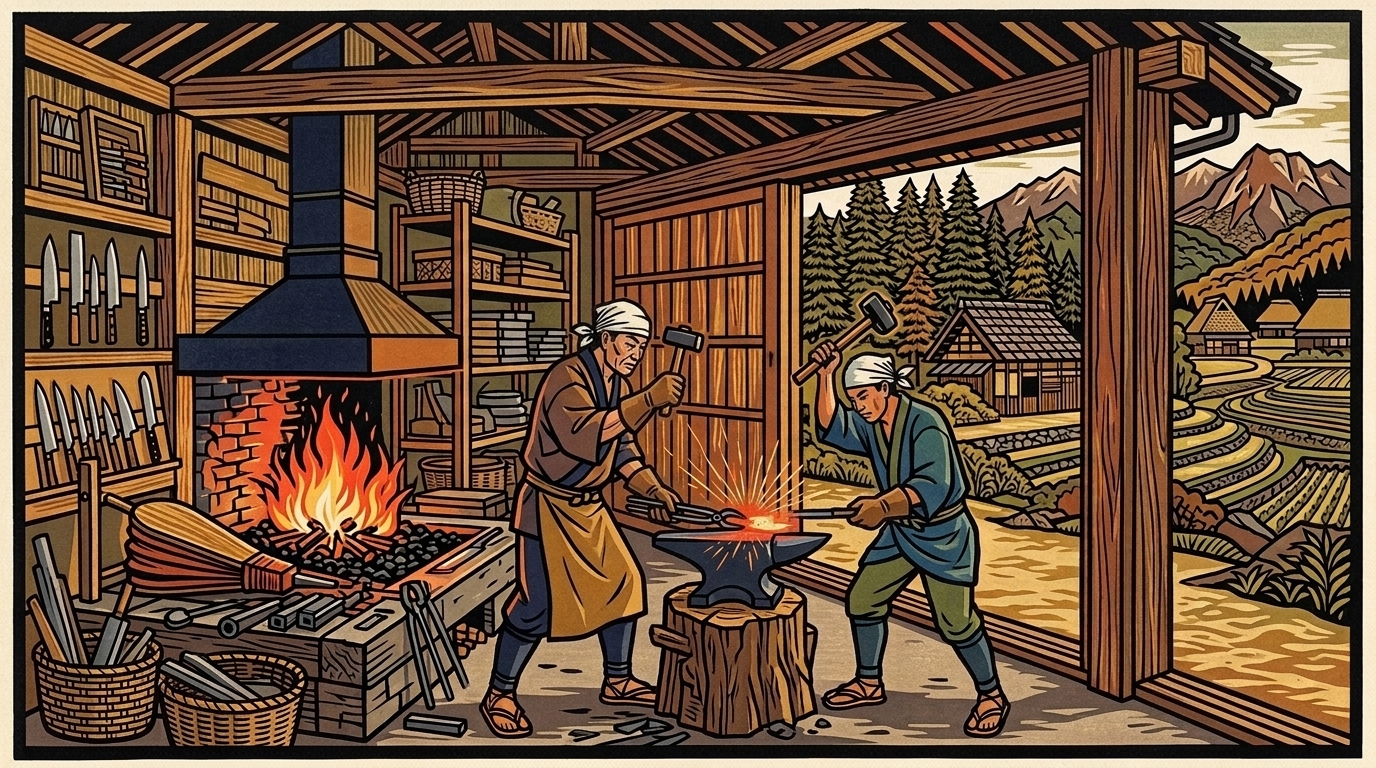
Explore signature cutlery makers, blacksmith ateliers, and historic shops of Echizen. Discover workshop heritage, specialty blades, price estimates, and verified links.
Blacksmith Workshop (Takefu Knife Village)
Kurosaki Knives (Yu Kurosaki / Makoto Kurosaki)
Led by certified Master Craftsman Yu Kurosaki alongside his brother Makoto (master sharpener), Kurosaki Knives is one of Japan's most sought-after modern ateliers. Celebrated for distinctive textured hammer finishes like 'Shizuku' (raindrop), 'Senko' (spark), and 'Fujin' (wind god), the workshop pairs super steels like SG2/R2 and Aogami Super with razor-thin convex geometry.
🔪 Specialty Blades:
SG2/R2 Hammered Chef Knives (Gyuto, Santoku, Bunka)Aogami Super Forged KnivesPetty & Sujihiki
🏷️ Price Range:
¥30,000–¥90,000 (Core range: ¥38,000–¥55,000)
Blacksmith Workshop (Takefu Knife Village Founder)
Takeshi Saji (Saji Hamono)
Born in 1948 and designated a Traditional Craftsman at age 44, Takeshi Saji is a living legend and co-founder of Takefu Knife Village. Renowned globally for forging outdoor hunting knives mounted with stag antler and exotic hardwoods, he now produces heavy-gauge kitchen cutlery featuring multi-layered Damascus cladding and high-speed powder steels (SRS13, VG10).
🔪 Specialty Blades:
Custom Japanese Hunting KnivesSRS13/VG10 Multi-layer Damascus CutleryIronwood & Stag Antler Handled Gyuto/Santoku
🏷️ Price Range:
¥35,000–¥130,000 (Core range: ¥45,000–¥75,000)
Blacksmith Workshop (Takefu Knife Village)
Yoshimi Kato (Kato Uchihamono)
Succeeding master smith Kintaro Kato, certified craftsman Yoshimi Kato leads Kato Uchihamono within Takefu Knife Village. Celebrated for surgical precision under the power hammer, Kato expertly forge-welds SG2 powder steel, Aogami Super, and nickel Damascus laminates into thin, acutely ground chef knives with exceptional cutting performance.
🔪 Specialty Blades:
Nickel Damascus Japanese KnivesSG2/R2 Powder Steel Santoku & GyutoAogami Super Kurouchi Blades
🏷️ Price Range:
¥28,000–¥85,000 (Core range: ¥35,000–¥55,000)
Cutlery Workshop & Manufacturer
Kunpei (Masutani Hamono)
Kunpei is the signature brand of Masutani Hamono, an atelier spanning four generations in Echizen. Named after master cutler Kunio Masutani, Kunpei knives offer remarkably affordable entry into Echizen craftsmanship. Featuring thin convex grinds on clad VG10 stainless steel cores, these knives deliver effortless food release and long-lasting sharpness for home kitchens.
🔪 Specialty Blades:
VG10 Multi-layer Damascus SantokuThin-ground Nakiri Vegetable KnivesPetty & Utility Knives
🏷️ Price Range:
¥8,000–¥22,000 (Core range: ¥10,000–¥15,000)
Blacksmith Workshop (Takefu Knife Village)
Anryu Knives (Katsushige Anryu / Takumi Ikeda)
Established in the early Meiji period with over 150 years of history, Anryu Knives is steered by fifth-generation smith Takumi Ikeda, succeeding legendary master Katsushige Anryu. Operating under the motto 'blades cut the user's heart,' the workshop emphasizes hand-hammered carbon steels (Aogami #2, Aogami Super) producing resilient, ultra-sharp cutting tools.
🔪 Specialty Blades:
Aogami Super Kurouchi Hammered CutleryAogami #2 Damascus Japanese KnivesSantoku, Gyuto, Sujihiki
🏷️ Price Range:
¥25,000–¥68,000 (Core range: ¥32,000–¥45,000)
Traditional Craftsman & Single-Bevel Specialist
Hideo Kitaoka
Born in 1950, Hideo Kitaoka is a rare specialist in Echizen who dedicated his life exclusively to single-bevel traditional Japanese kitchen cutlery. Forging multi-layer Damascus steels around Shirogami and Aogami cores, his Yanagiba, Deba, and Usuba blades showcase intricate swirling patterns combined with deeply hollowed urasuki backs tailored for culinary masters.
🔪 Specialty Blades:
Single-Bevel Damascus YanagibaHand-Forged Heavy DebaSushikiri & Mioroshi Deba
🏷️ Price Range:
¥30,000–¥95,000 (Core range: ¥40,000–¥65,000)
Traditional Craftsman & Multi-disciplinary Smith
Nao Yamamoto
Born in 1979, Nao Yamamoto is a versatile certified Traditional Craftsman within Takefu Knife Village who personally completes every production phase—from fire-welding and bevel grinding to custom wooden handle shaping and matching saya sheath carving. Beyond kitchen knives, he is celebrated for traditional mountain knives (Makiri) and rugged outdoor blades.
🔪 Specialty Blades:
VG10 / Aogami Forged Santoku & GyutoEchizen Traditional Mountain Knives (Makiri)Custom Handcrafted Outdoor Blades
🏷️ Price Range:
¥22,000–¥70,000 (Core range: ¥30,000–¥45,000)
Luxury Cutlery Maker & Flagship Gallery
Ryusen Hamono
Founded in 1953 as a blade sharpening workshop, Ryusen Hamono established full in-house forge and heat-treatment facilities in Echizen. Worldwide fame arrived when their 'Asymmetry SK01' steak knife was chosen by Team Japan at the Bocuse d'Or culinary competition. Lines like 'Bonten Unryu' (70-layer Damascus) exemplify their union of traditional metallurgy and contemporary luxury design.
🔪 Specialty Blades:
Luxury Table & Steak Knives (Asymmetry)SG2 / VG10 Multi-layer Damascus Cutlery (Bonten Unryu)Santoku & Chef Knives
🏷️ Price Range:
¥25,000–¥150,000+ (Steak knives: ¥30,000+ / Kitchen cutlery core: ¥35,000–¥60,000)
Shared Blacksmith Atelier & Open Factory
Takefu Knife Village (Cooperative Atelier)
Established in 1993, Takefu Knife Village is a world-renowned open factory created by Echizen blacksmiths and industrial designer Kazuo Kawasaki to foster craftsmanship continuity. Visitors can observe master artisans hammering red-hot steel from elevated viewing catwalks and acquire pieces directly from member ateliers (Saji, Kurosaki, Kato, Anryu, Kitaoka) in their flagship gallery.
🔪 Specialty Blades:
Complete Catalog from Resident Master SmithsTKVO Minimalist Designer KnivesSantoku, Petty, Outdoor Cutlery
🏷️ Price Range:
¥15,000–¥120,000+ (Broad spectrum from apprentice pieces to collector custom blades)